
Josephine Alger, Firecracker-in-Residence
By Betsy Alexander
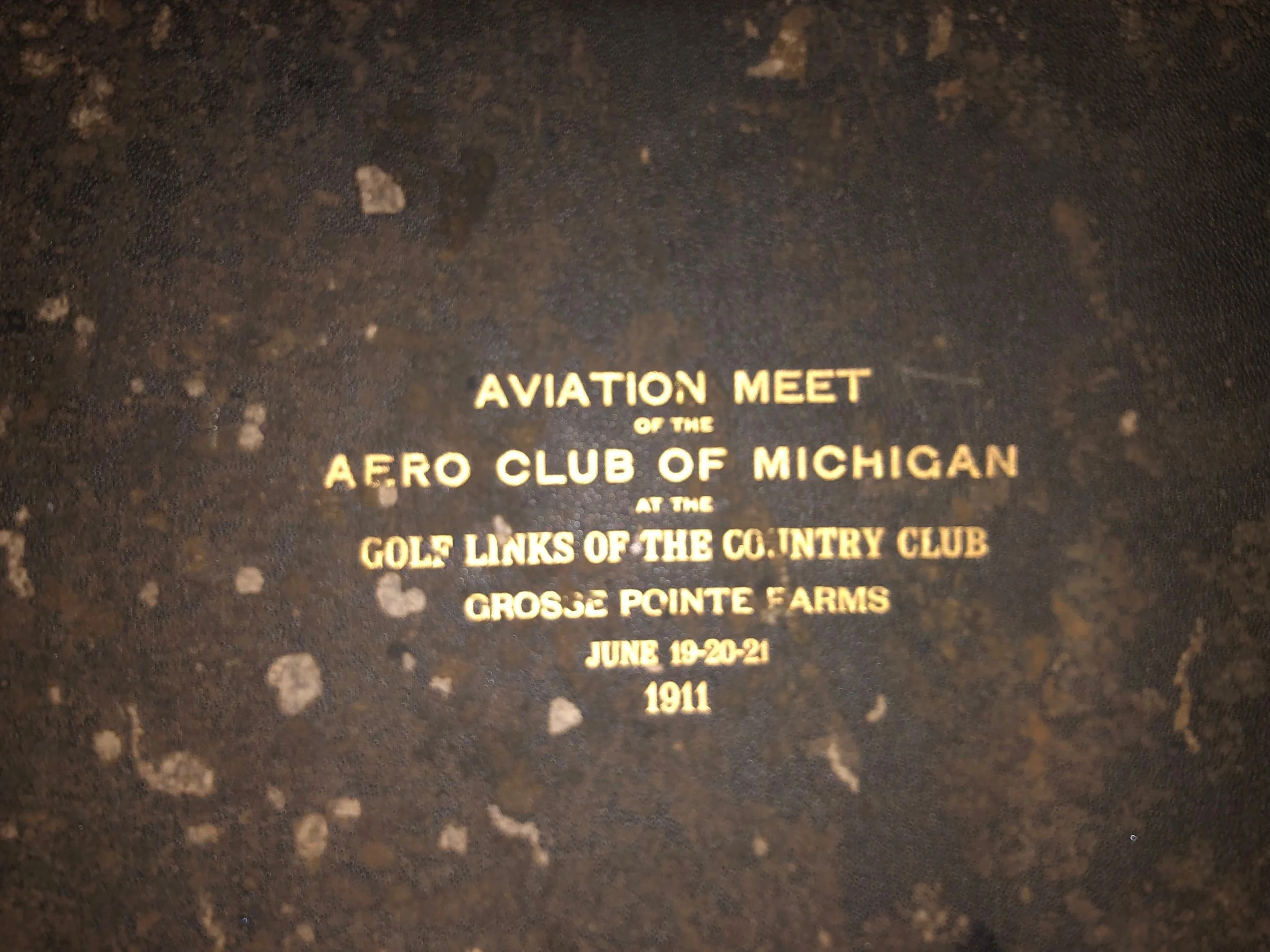
The aerial exhibition book cover
This June will mark 115 years since Russell Alger Jr., President of the Aero Club of Michigan, organized his Aviation Meet at the Golf Links of the Country Club, located where Grosse Pointe South High School’s athletic field is now. The event, held June 19 – 21, 1911, was to garner publicity and additional financial interest in the Wright Brothers, whom Russell and his brother, Fred Alger advised.
The new Model B biplane that was used was both untested and a very primitive looking contraption, although considered state of the art at the time. The Wright’s top pilot, the ill-named Frank Coffyn, and one guest were seated on plain wooden seats without arms or seat belts.
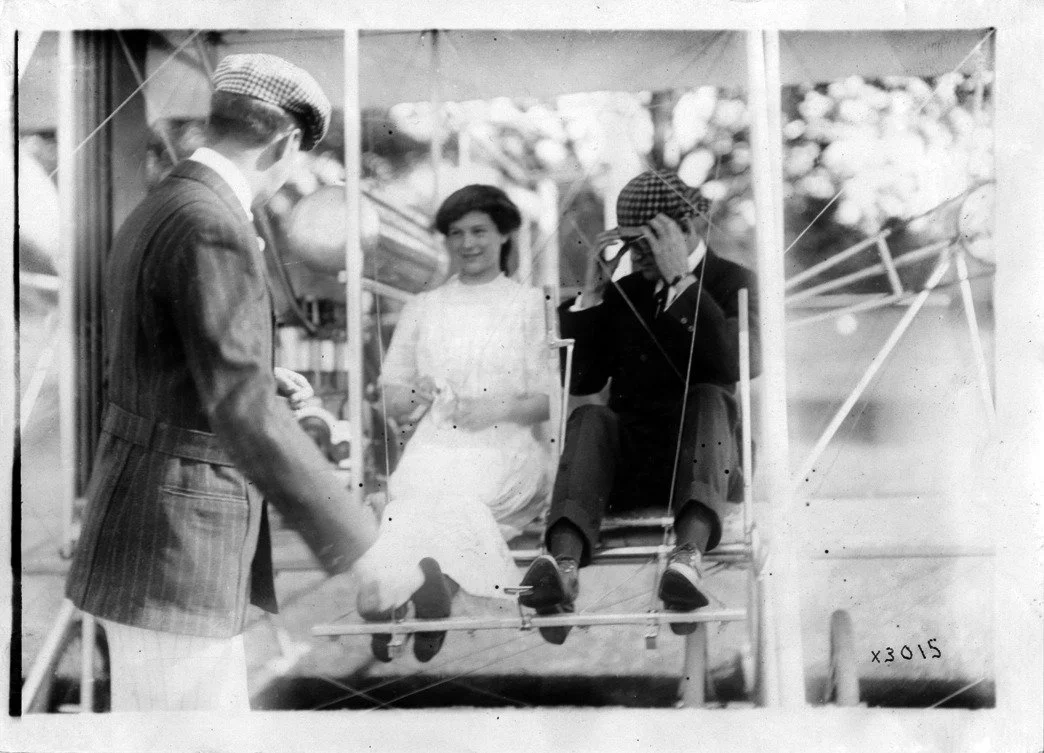
Josephine Alger embarking on her history-making flight with Frank Coffyn, 6/19/1911
Always appreciating a good challenge or scare, Josephine Alger, Russell’s 14-year-old daughter, was the first person up with Coffyn on the morning of June 19. Josie was a thrill seeker just like her father, and her history-making flight marked the first non-adult in America to fly. That afternoon, her mother, Marion, and Fred’s wife, Mary, flew, making them the first two Michigan women in flight.
Quickly following her marriage to lumberman and big game hunter Henry Francis Chaney on June 21, 1916, she gave birth to her first child, Henry F. Chaney Jr. on March 22, 1917; he was the only person born at “The Moorings.”
Junior had just graduated from Yale and was about to continue his law studies at the University of Michigan when the United States entered World War II. Like most young men, he put his personal future on hold and signed up to be a naval flyer. On October 14, 1942, just three weeks after arriving at Guadalcanal, he was blown up by heavy Japanese shelling at Henderson Field.
Josephine sent the following handwritten note to General Harry Schmidt (USMC) who was in charge of the Pacific Theater in response to his letter of condolence:
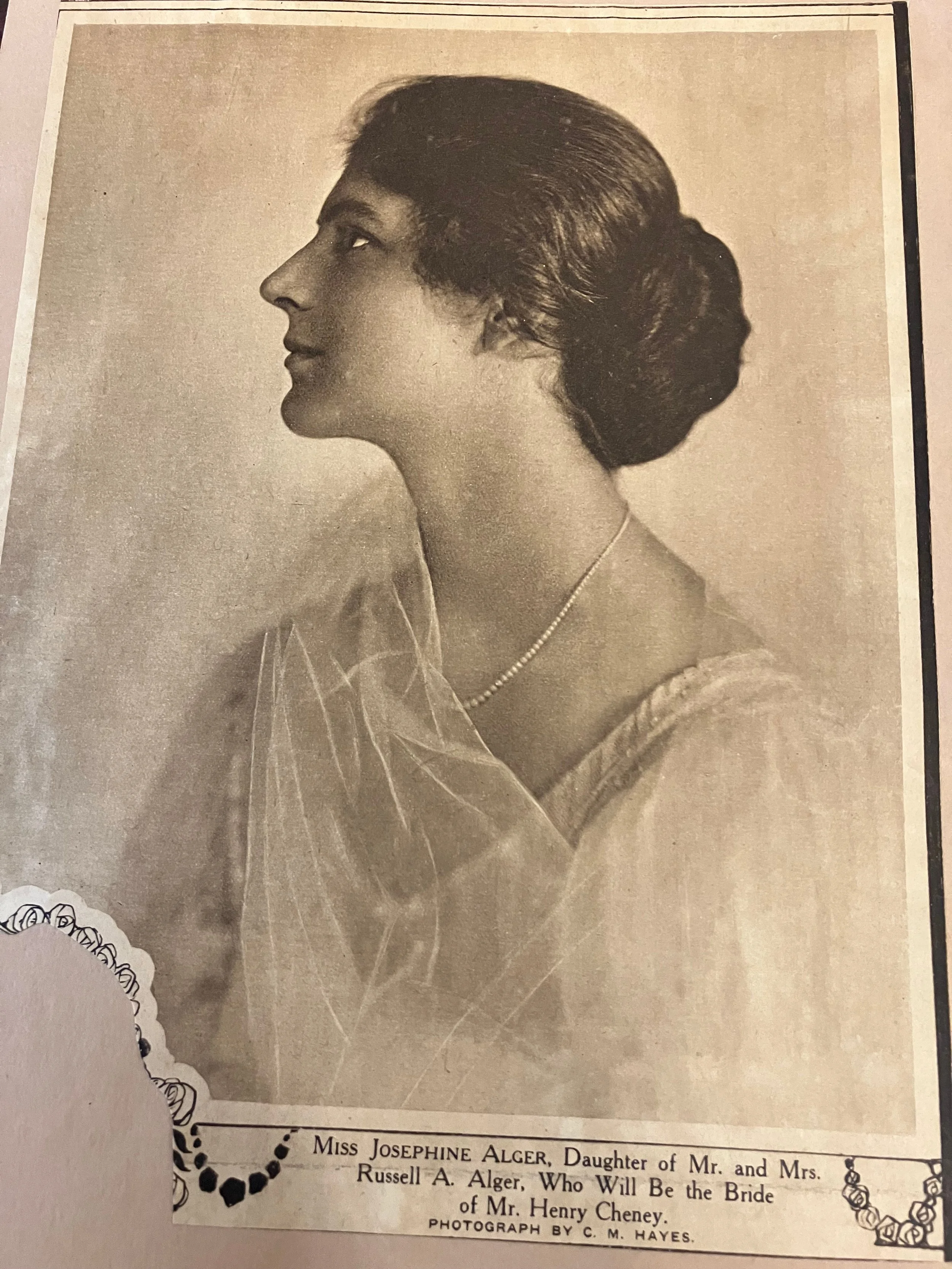
Josephine Alger’s official engagement photo
“My son came of a line of American statesmen, fighters, and builders. He believed ardently in the privilege of his birthright. To maintain these privileges, he chose his way to serve his country. His only regret would have been to have served for so short a time.”
“We have received from all walks of life many beautiful tributes to him. Many of these letters say how sad it is that the best of our youth should be the first to go. I cannot feel this way. If our young leaders as well as our tried leaders are not the first into battle, who would follow, and from where would victory come?”
Although devastated, Josephine’s positive reaction to Henry’s death was to supply all of the recreation building’s furnishings at the Detroit Naval Armory (now the Brodhead Armory) so that other young men would have a fun, comfortable place to gather or relax before shipping out. She went on to do the same at every military installation throughout Michigan via her Day Room program through the Red Cross. The loss of Henry Jr. greatly impacted the Alger family’s decision to donate their former estate to the Grosse Pointe War Memorial Association in March of 1949 to be used as a veterans’ memorial for those who served and those who didn’t return home.
During Josephine’s marriage to Henry Chaney, they lived in Oregon, but she was frequently back in Grosse Pointe visiting or staying with mother Marion who was both Russell Alger’s wife and fulltime nurse after his paralysis in 1921. By 1929, the Chaney’s were divorced and Josephine was living home again fulltime.
She was still in Grosse Pointe when Russell passed in January 1930 but was preparing for her marriage later that spring to her second husband, David Dwight Douglas. Douglas was Michigan’s Chief of Naval Intelligence and a Washington DC insider. The Douglas’ lived in Grosse Pointe and Josephine was frequently involved with her former residence during both its Detroit Institute of Arts years (1936-1948) and its evolution into The War Memorial. She was also involved with the Neighborhood Club and Thrift Shop, on The War Memorial board of directors, and involved with many major planning decisions. It is Josephine who financed the removal of the green paint on the dining room paneling left after the DIA exited. She also corralled her two Alger siblings to pool resources to freshen up the knot gardens, and install new garden lighting, walkways, and the large rectangular pool with a water sculpture that most Pointers fondly remember.
One infamous story recounts Josephine, an enthusiastic gardener and always a free thinker, pulling up at The War Memorial in her Rolls Royce - with a trunk load of free horse mature for the gardens. There are no photos or irrefutable witness accounts of the incident, unfortunately.
Josephine married a third time upon Douglas’ surprise passing at their home in 1951, taking importer and Swedish dignitary Nils R. Johanesen as her third husband in 1956. The Johanesen’s were frequent guests at War Memorial events and Josephine was pictured often in the papers, usually laughing and enjoying herself immensely. Alas, Nils also left her widowed, dying just before Christmas of 1975 at Detroit’s Jennings Hospital.
On April 24, 1983, Josephine passed away at Bon Secours Hospital after a brief illness; three children survived her. At the time of her death, she was still a member of the prestigious Founders Society of the Detroit Institute of Arts and a member of the Detroit Historical Society and Michigan Garden Club, among other organizations. Josephine Alger, Henry Chaney Jr., David Douglas, and Nils Johanesen are all at historic Elmwood Cemetery.
From sitting atop the tile roof of “The Moorings” and setting a flight historical record as a child; giving elegant voice as a distraught Gold Star mother; providing respite for Michigan’s service personnel; and taking charge of decisions to improve her former residence for the community, Josephine Alger was one heck of a Grosse Pointe “doer” and never just an idle talker.