
Service and Serendipity: A veteran’s love story began at the War Memorial
A happenstance interaction at The War Memorial, and 63 years later, they are still together.
“We met at a singles dance,” Jerry Bresser said.
That dance was in 1962, the same year that Jerry and Jean Bresser married.
“Jean was sitting in a chair, waiting for somebody and John Lake, the director at the time, came out,” he said. “Tables were set up, and I was talking to a friend and she looked very good to me. John introduced the two of us and I got to sit next to her.”
A week later, he proposed, but the answer was no. Later in 1962, they married in England, where Jean was from. The couple has four kids, and eight grandkids. His most recent War Memorial experience came in November for Veterans Day Breakfast.
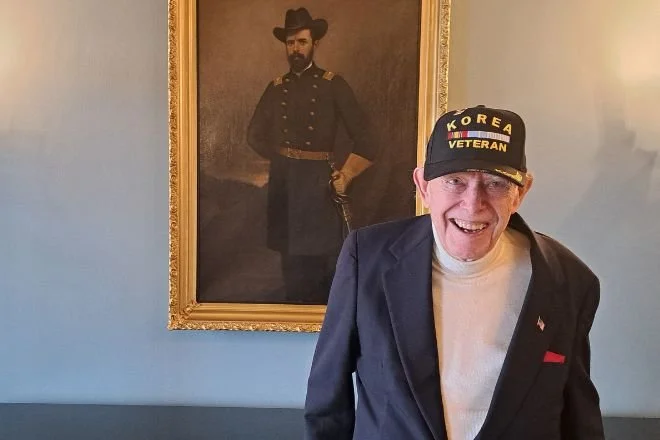
Jerry Bresser is pictured in the Alger House Library in front of a portrait of Russell A. Alger Sr. The portrait depicts Alger in his Civil War Union uniform.
Born in New York City, Jerry Bresser graduated from University of Detroit Jesuit High School in 1951.
“I was hearing that it was a nasty war,” he said. “When you’re a teenager, you’re not paying attention.”
Bresser, 92, is the son of a World War I Navy veteran. Knowing that he could be drafted and wanting to have a better choice of what he did in the military, Bresser enlisted in the Army in August 1952.
Sent to Fort Devens in Massachusetts to learn Morse code, training which took nine months, Bresser became a code interceptor operator with the 329thCommunication Reconnaissance Company, part of the Army Security Agency.
“A recruiter told me how great it was going to be because we had lots of time off and could go to a lot of big places,” he said. “We had top secret clearances.”
Bresser, of Grosse Pointe, explained that his responsibilities included listening to coded messages being sent back and forth between enemy troops, which in the case of the Korean War was North Korean and Chinese personnel.
“We copied it down and would send data back to Langley where it was decoded,” he said. “I learned to speak enough Chinese so I could understand what they were saying.”
Arriving in 1953 just prior to the Korean Armistice Agreement being signed, Bresser was stationed near the 40th parallel in South Korea. He primarily operated from the back of a 2½-ton cargo truck.
“I was in Korea for about one year,” he said. “The Chinese changed call signs and frequencies every day, so the only way you could track them down was by recognizing the tonality of the transmitter. You needed to learn to listen to the sound. The average speed of the code being sent was 38 words a minute. It was five numbers for a word.”
Feeling that he was doing something worthwhile, Bresser’s mindset toward his work in the Army was to do it “real good.”
After service in Korea, Bresser was stationed in Japan, continuing to intercept code. He was discharged in July 1955 with the rank of corporal.
In response to what he would like younger generations to know about the Korean War, Bresser said it’s not about the war, rather, military service.
“John F. Kennedy started the Peace Corps because he wanted people to have military or public service because they weren’t drafting as many people,” he commented. “I recommend military service because there is discipline in being a military soldier.”
A rather memorable experience for Bresser came when he met and had dinner with Norman Schwarzkopf, the commander of United States Central Command and a four-star Army general.
“He was in Detroit speaking at a seminar and toward the end of the day, my friend asked if I wanted to have dinner with him,” he said. “There were about 10 other people there, including my wife.”
Bresser said he asked him questions like how he got his start in the Army and why he was picked to command the Army.
“He said ‘I wasn’t looking for the job, but I was prepared to do what they wanted me to do,’” Bresser said.
To view more veteran stories and upcoming patriotic programming at The War Memorial, visit warmemorial.org/patriotic.