
Medal of Honor recipient shares story of endurance, leadership and honor
From Sept. 30 to Oct. 3, Detroit will host the 2026 Congressional Medal of Honor Society Convention. This marks the first time that the convention, the largest annual gathering of America's 65 living Medal of Honor recipients, will be in Michigan. Today we hear from Vietnam War veteran Gary Littrell.
Once he received it, Gary Littrell realized that he now had a responsibility of being a Medal of Honor recipient.
“Especially staying on active duty. Your soldiers looked at you as you are the expert in everything because you're a Medal of Honor recipient,” he said. “I couldn't make a mistake because my soldiers held me in such high esteem that I had to live up to their expectations.”
That message came to Littrell from an Army general in October 1973, just two weeks prior to receiving the medal at the White House.
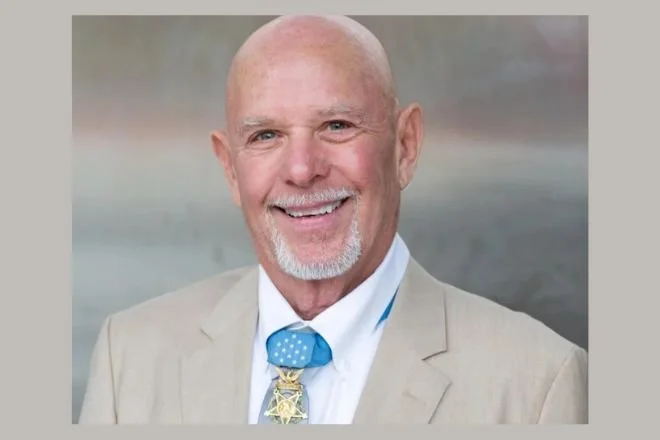
“When I was talking on the couch with General Barry, he said I'll share something with you now that you won't understand, but you will someday,” Littrell recalled. “It's gonna be harder to wear that medal than it was to receive it.”
At the time of his Medal of Honor action, Littrell was a sergeant first class.
From April 4 - 8, 1970, his action dates, Littrell is credited with averting excessive loss of life and injury to the members of the battalion. All this took place in Kontum Province, Vietnam.
Coming from a “very dysfunctional family” in Kentucky where his dad ran off when he was 3 and his mother was killed when he was 5, Littrell enlisted in the Army in 1961 on his 17th birthday.
“I signed the contract when I joined the Army to go to airborne school,” he said. “After basic and AIT, I went to Fort Benning, Georgia for airborne school and then went to Okinawa to serve with the 503rd Airborne Battle Group.”
Littrell arrived in Vietnam in April 1969. When he first got to Saigon, he thought it was very overpopulated and dirty. Once he got to his unit in Pleiku, he called it a very interesting and beautiful country.
“We were in the mountains and the people were outstanding. The little Vietnamese Rangers were really some hard fighting young men,” he shared.
Part of Advisory Team 21, II Corps Advisory Group, U.S. Military Assistance Command, Littrell’s official role was an advisor to the Vietnamese.
“They didn't need our advice,” he said. “99% of my duties was calling in American support. If we got in contact, we’d call in fast movers out of Thailand, artillery and then we moved by chopper and I had to coordinate all of that. My job was basically American support.”
On Advisory Team 21, there were four advisors to each battalion, and there were three battalions.
Summarizing his Medal of Honor action, Littrell said the mission was to move to the Special Forces base camp in Dak Seang that had been overrun.
“They were overrun by the 29th NVA Regiment, the 66th NVA Regiment and the K-6 Sniper Battalion. The Special Forces base camp was pretty much annihilated. What I didn’t know then was one of my best friends and a fellow Medal of Honor recipient, Gary Beikirch, was in that base camp.”
It was while setting up base camp, that the hill Littrell was on became surrounded.
“We went into a nonstop four-day, four-night battle,” he recalled. “At the end of the battle, I was the only advisor out of the four left, and I had 41 walking wounded out of the 473 Vietnamese Rangers.”
Over the course of the battle, he estimates 473 Americans and their Vietnamese counterparts were up against roughly 5,000 North Vietnamese forces.
“We had the advantage with the high ground and of course we had air,” he said.
One memory that is more vivid from his Medal of Honor action dates is calling in air strikes that were dangerously close.
“I had no choice, and I had to argue with the Air Force because they didn't want to drop it that close,” he said. “I called it in within 50 meters of our own position, and the reason I did was the enemy was right on our doorstep. I just have to say, look, you got to bring it in before I need it. If not, they are going to kill me. I’ve got to have it and have it in close.”
Littrell was presented the Medal of Honor on Oct. 15, 1973, by President Richard Nixon.
“The presentation itself was very small,” Littrell said. “There were nine of us because it had been over four years since any Medal of Honors were presented because the Vietnam War was not a popular war, and Nixon was in trouble because of Watergate.”
With the soon-to-be recipients lined up in a row, Littrell said that Nixon placed the medal around their necks, shook hands and moved to the next person.
“I laugh and say my presentation was between Watergate and goodbye, so he had bigger fish to fry that day than us,” he said.
For more details on the convention, visit medalofhonordetroit.com.